 Cichlid
Water changes are the single best thing you can do for a cichlid tank, and the thing most of us skip when life gets busy. Oscars, big Central Americans and crowded mbuna tanks produce a lot of waste, and nitrate climbs fast. An automatic drip water change system fixes that by changing a little water all day, every day, without a bucket in sight.
This guide walks through what a drip system is, the parts you need, how to put one together, how fast to drip for your tank size, and the failsafes that keep it from flooding the room or poisoning your fish.
What is a drip water change system?
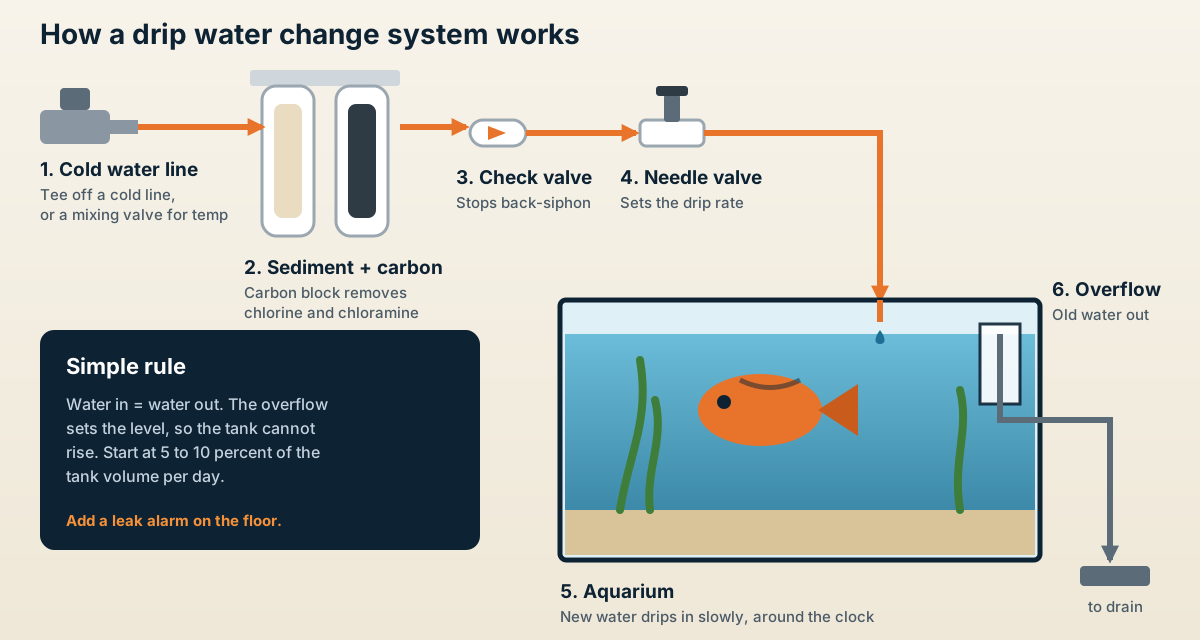
A drip system feeds a slow, steady trickle of clean, dechlorinated water into the aquarium, and an overflow lets the same amount of old water leave to a drain. Water in equals water out, so the level never changes. Instead of one 30 percent change on Saturday, the tank gets a small change every minute of the day.
Why cichlids and oscars benefit
- Lower, steadier nitrate. Big messy eaters like oscars, Jack Dempseys, green terrors and frontosa push nitrate up quickly. A drip keeps it low and flat instead of a sawtooth that spikes between changes.
- Fewer swings. Tiny constant changes avoid the sudden temperature and pH shifts of a big manual change, which is easier on fish prone to stress.
- Less hole in the head risk. Poor water quality is one of the most commonly cited factors in HITH in oscars and discus. Clean water around the clock helps.
- It actually happens. The best water change schedule is the one that never gets skipped.
The parts you need
A basic tap-fed drip system has six or seven parts. Most of them are the same fittings reef keepers use for RO/DI top-off, so they are easy to find in 1/4" push-to-connect sizes.
- Water source. A cold water line, ideally teed off under a sink or at a washing machine valve with a saddle or tee valve.
- Sediment and carbon block filter. A sediment stage catches grit, and a carbon block removes chlorine and chloramine. This is essential. If you want soft water, use an RO/DI unit instead, which includes both.
- Check valve. A one-way valve that stops tank water from ever siphoning back into your household plumbing.
- Needle valve or drip emitter. This sets the drip rate. A needle valve gives the finest control. Irrigation emitters rated in gallons per hour also work.
- Drip line tubing. 1/4" food-grade RO tubing from the filter to the tank.
- Overflow or drain. A drilled bulkhead, a hang-on overflow box, or a sump standpipe that carries old water away.
- Float valve (optional). Useful on a reservoir or sump to shut off flow at a set level. It is a backup, not a replacement for the overflow.
- Leak detectors. Small battery alarms on the floor. Cheap and worth it.
Our filtration gear finder and water care gear finder cover the filters and conditioners we recommend for cichlid tanks in more detail.
Equipment for a drip system
These are the parts we would use to build a drip system for a cichlid or oscar tank. As an Amazon Associate, Cichlid Nation earns from qualifying purchases.

AquaticLife 2-Stage Sediment and Carbon Plus Water Filter
A sediment stage plus a carbon block rated for chloramine. This is the heart of a tap-fed drip system.
Check price on Amazon
LiquaGen 6-Stage RO/DI System, 100 GPD
Go this route if you keep discus, angels or wild South Americans and want to control hardness.
Check price on Amazon
Kent Marine Float Valve
Shuts off flow at a set level. Use it on a reservoir or sump, not as your only overflow.
Check price on Amazon
LiquaGen 1/4" Push-to-Connect Needle Valve
Fine control from a few drips a minute up to several gallons a day.
Check price on Amazon
Aquatic Life 1/4" Check Valve
One-way flow, so tank water can never run back into your plumbing.
Check price on Amazon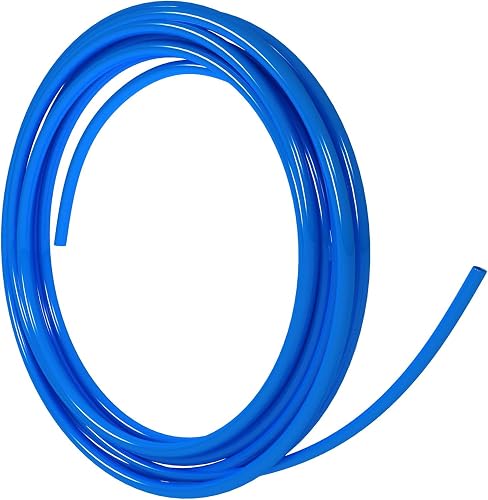
AquaticLife 1/4" RO Tubing, 50 ft
Food-grade 1/4" line that pushes straight into the valves above.
Check price on Amazon
Govee Water Leak Detector, 100dB
Cheap insurance. Put one under the stand and one by the drain.
Check price on Amazon
Seachem Prime, 500 ml
Keep a bottle on hand for main breaks and for dosing if a carbon block is overdue.
Check price on AmazonStep-by-step setup
- Plan the drain first. Decide where old water goes before you add any water. A floor drain, utility sink, or a line out to the garden all work. The drain must be lower than the overflow and able to handle the flow forever.
- Set up the overflow. On a drilled tank, fit a bulkhead with a standpipe or strainer at the water level you want. On an undrilled tank, use a hang-on overflow box or route through your sump. Put a strainer or sponge on the intake so fry and small fish cannot leave.
- Tap the cold water line. Install a tee or saddle valve on a cold line and run 1/4" tubing to where the filter will sit. Turn the water off at the valve while you work.
- Mount the filter. Fix the sediment and carbon housings to a wall or cabinet side, with the flow arrow pointing the right way. Flush each new cartridge to waste for a few minutes before connecting to the tank.
- Add the check valve. Place it after the filter, pointing toward the tank.
- Add the needle valve. Place it after the check valve, close to the tank where you can reach it to adjust.
- Run the drip line. Secure the end of the tubing above the water line with a clip or tubing holder so it can never siphon. Aim it into a high-flow area so new water mixes quickly.
- Set the rate. Open the needle valve slowly. Catch the drip in a measuring cup for one minute and do the math below. Adjust until you hit your target.
- Watch it for a day. Check the water level, the drain line and the floor several times on day one, and again after a week.
Drip rate by tank size
A good starting point is 5 to 10 percent of the tank volume per day. Measure how many milliliters you collect in one minute, then multiply by 0.38 to get gallons per day. For example, 15 ml per minute is about 5.7 gallons per day.
| Tank size | Light stocking (5%/day) | Typical (10%/day) | Heavy, oscars or mbuna (15%/day) | Approx. ml per minute at 10% |
|---|---|---|---|---|
| 40 gal | 2 gal/day | 4 gal/day | 6 gal/day | 10 ml |
| 55 gal | 2.75 gal/day | 5.5 gal/day | 8.25 gal/day | 14 ml |
| 75 gal | 3.75 gal/day | 7.5 gal/day | 11.25 gal/day | 20 ml |
| 125 gal | 6.25 gal/day | 12.5 gal/day | 18.75 gal/day | 33 ml |
| 180 gal | 9 gal/day | 18 gal/day | 27 gal/day | 47 ml |
| 220+ gal | 11 gal/day | 22 gal/day | 33 gal/day | 58 ml |
Start low, test nitrate weekly, and nudge the rate up if nitrate keeps rising. Most oscar tanks settle happily around 10 percent a day.
Temperature matching
At these rates new water is a tiny fraction of the tank, so your heater usually handles cold water without trouble. Two cases need care:
- Very cold winter water. In northern climates the cold line can drop near 40°F. Slow the drip, size your heater with some extra headroom, or feed from a tempered line.
- Using a mixing valve. A thermostatic mixing valve blends hot and cold to a set temperature. Never feed from the hot line alone, since water heaters can add metals and the temperature is unpredictable.
Check the tank temperature with a separate thermometer for the first few days after you start the drip.
Overflow and drain options
- Drilled tank with a bulkhead. The most reliable choice. A standpipe or elbow sets the water level and gravity does the rest.
- Hang-on overflow box. Works on undrilled tanks. Choose one with a U-tube that holds its siphon, and keep the drip rate well below its rated flow.
- Sump standpipe. If you run a sump, drill or plumb a standpipe in the sump at the level you want, and send the excess to the drain.
- Where it goes. A floor drain or laundry standpipe is ideal. Nitrate-rich water is also great for houseplants and the garden, as long as you are not dosing medications.
Safety and failsafes
A drip system runs while you sleep and while you are away, so build in protection against the two real risks: water on the floor and chemicals in the tank.
Leaks and floods
- Use quality push-to-connect fittings and push the tubing all the way in until it seats.
- Put leak alarms under the stand, under the filter and near the drain.
- Keep the drip rate far below what your overflow and drain can carry.
- Consider a float valve or a timer on a solenoid valve as a second shutoff.
- Make sure the drip line ends above the water so it can never siphon the tank out.
Chlorine, chloramine and the water main
- Find out whether your city uses chlorine or chloramine. Chloramine needs a carbon block rated for it, not just granular carbon.
- Utilities sometimes flush the system with extra chlorine, or a main break stirs up sediment. If you get a notice, close the drip until it is over.
- Replace carbon blocks on schedule, or sooner on a high-flow tank. Test for chlorine with a simple strip after replacing a cartridge.
- Keep a bottle of a dechlorinator like Seachem Prime as a backup for emergencies.
Maintenance
- Weekly: glance at the water level, drain and fittings, and test nitrate.
- Monthly: check the drip rate with a measuring cup, since needle valves can drift or clog. Clean the overflow strainer.
- Every 3 to 6 months: replace the sediment cartridge. Replace the carbon block on the maker's schedule or by gallons used.
- Every few weeks: keep vacuuming the substrate and rinsing filter media. The drip handles dissolved waste, not solid gunk.
Want a second opinion on your setup? Post photos and questions in the community, and read our water change and maintenance guide for the basics.
Frequently asked questions
How many gallons per day should a drip system change?
Start at 5 to 10 percent of the tank volume per day. For a 75 gallon oscar tank that is roughly 4 to 8 gallons a day. Heavily stocked tanks can run up to 15 percent once you know the water is stable.
Do I still need to do manual water changes with a drip system?
Yes, but less often. A drip keeps nitrate low between cleanings, but you still need to vacuum the substrate and rinse filter media every few weeks.
Is tap water safe to drip straight into a cichlid tank?
Only through a carbon block rated for chlorine and chloramine. Untreated tap water can carry enough chlorine or chloramine to burn gills, even at a slow drip.
What happens if the water company flushes the mains with extra chlorine?
Your carbon block may not keep up. Shut the drip off for a day or two when you get a notice, keep a dechlorinator like Seachem Prime on hand, and replace the carbon block on schedule.
Do I need RO/DI water for cichlids?
Most African and Central American cichlids, and oscars, do fine on filtered tap water. RO/DI is mainly for soft water fish like discus and wild Apistogramma, or if your tap water has problems such as high nitrate or phosphate.
Will cold drip water shock my fish?
At a normal drip rate the new water is a tiny fraction of the tank and the heater keeps up easily. If your cold line is very cold in winter, use a thermostatic mixing valve or slow the drip.
Can I run a drip system without drilling the tank?
Yes. A hang-on overflow box or a sump with a standpipe both work. Drilled tanks are the most reliable, but plenty of keepers run drips on undrilled tanks.


